


Cosmic Fables: When Mathematics Becomes Wonder

How the Story of Numbers Opens Children's Imagination to Cosmic Education
When Knowledge Becomes Narrative
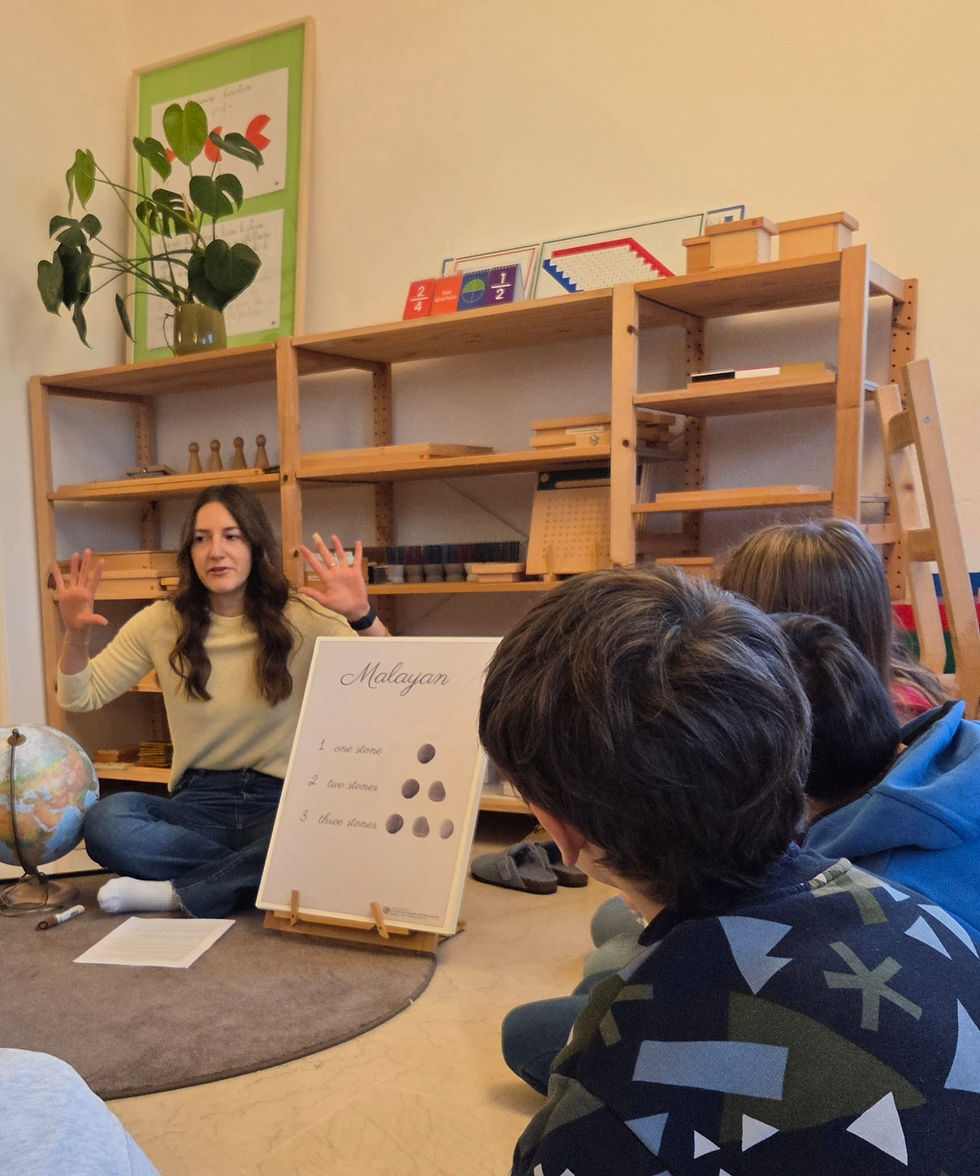
A group of children sitting in a circle on the carpet, eyes fixed on the Guide. In front of them, posters with mysterious symbols - Sumerian wedges, Egyptian hieroglyphics, Roman numerals, Chinese characters. The guide begins to tell: "A very, very long time ago, human beings didn't have numbers as we know them today..."
This is not a math lesson. It's a story that crosses millennia, continents, civilizations. It's one of the five great Montessori cosmic tales - narratives that open Elementary children's imagination to the grand design of the universe and humanity.
This is cosmic education in action.
What Are Cosmic Fables
Cosmic tales are five great narratives that Maria Montessori created to introduce Elementary children to the great themes of human knowledge:
The Story of the Universe (God who has No Hands) - the origin of the cosmos, natural laws
The Timeline of Life - the arrival of life, evolution
The Story of the Coming of Human Beings - what makes humans unique
The Story of Writing - how humanity learned to communicate through symbols
The Story of Numbers - how different cultures developed systems to count and calculate
They are not invented tales. They are true, poetic, profound stories - told with language that touches children's imagination and ignites questions, curiosity, wonder.
Why Cosmic Fables Are the Heart of Cosmic Education

Montessori cosmic education is based on a simple but revolutionary idea: everything is connected.
The universe is not divided into separate subjects - history, geography, mathematics, sciences. It's a grand interconnected design where every element has a role, a function, a cosmic task.
Cosmic tales are the starting point of this journey.
Through narrative:
They ignite wonder - children discover that behind what they take for granted there's a fascinating origin
They show interconnection - each tale touches different disciplines
(history, geography, mathematics, anthropology, language)
They give a sense of belonging - children understand they are part of a bigger story, heirs to millennia of human discoveries
They stimulate gratitude - everything we use today is a gift from those who came before
They open infinite research - from each tale emerge questions, curiosities, paths of exploration
Cosmic tales don't close. They open. They don't give definitive answers. They sow questions.
The Story of Numbers: A Journey Through Civilizations

The fifth cosmic tale - the posters are those you see in the photo here - tells how humanity developed numerical systems.
How the Narrative Begins
The Guide tells that long ago, when human beings began to live in communities, they felt the need to count. Count animals, count harvests, count days, count people.
At first they used stones, sticks, knots on ropes. But when quantities increased, something more complex was needed. So, different cultures, at different times, in different places, invented systems to represent numbers.
The Journey Through Civilizations
The Guide shows the cards - each card represents a numerical system from an ancient civilization:
Sumerians (Mesopotamia, 3500 BC) - cuneiform symbols carved in clay
Egyptians (Ancient Egypt, 3000 BC) - hieroglyphics with different symbols for units, tens, hundreds
Greeks - alphabet letters used as numbers
Romans - the system we still use today for clocks, chapters, monuments (I, V, X, L, C, D, M)
Maya (Central America, 300 AD) - a positional system with dots and lines, inventors of zero
Chinese - vertical characters with specific meanings
Indo-Arabic system (India, 500 AD) - the system we use today: ten symbols (0-9) with positional value
Children discover that the number "5" wasn't always written this way. For Romans it was V. For Maya it was a line. For Egyptians it was a stick repeated five times. For Chinese it was 五.
The Revolution of Zero
A crucial moment in the narrative is the discovery of zero. Children discover that not all civilizations had zero. Romans didn't have it. Greeks didn't have it.
The Maya invented it in America. Indians perfected it in Asia.
Zero is not "nothing" - it's a revolutionary idea that changed mathematics forever.
The Journey of Numbers Around the World
The story continues: the Indo-Arabic system traveled from India to Persia, then to the Arab world (hence "Arabic numerals"), then to Europe through Islamic Spain, finally throughout the world. Today we use these symbols everywhere - but it wasn't always this way.
What Children Really Learn
When a child listens to the Story of Numbers, they're not just learning mathematics. They're learning much more:
Critical and Historical Thinking
Numbers are not "natural" - they are human inventions
Different cultures solved the same problem in different ways
What we take for granted today is the result of centuries of evolution
Geography and Cultural Interconnection
Where did the Sumerians live? The Maya? The Indians?
How numbers traveled from one continent to another
The role of trade routes in the spread of knowledge
Deep Mathematics
Positional vs non-positional systems
The concept of base (decimal, Maya vigesimal)
The revolutionary value of zero
Advantages and limitations of different systems
Language and Symbols
How symbols represent abstract concepts
The importance of writing in mathematics
The connection between writing and numbers
Gratitude and Belonging
Every symbol we use is a gift from those who came before
We are part of a story millennia long
Knowledge is humanity's heritage, not of a single culture
How It Continues After the Presentation

The cosmic tale is not an endpoint. It's a starting point.
After the presentation, children can:
Explore a specific civilization - do a Great Research on the Maya, Egyptians, Sumerians
Compare numerical systems - create comparative tables, discover advantages and disadvantages
Try writing with ancient systems - write their name or age in Roman, Egyptian, Maya numerals
Explore the concept of zero - why is it so important? What happens without zero?
Map the journey of numbers - create a geographic timeline of how numerical systems spread
Connect to language - research the etymology of numerical words in different languages
The Guides observe which children become passionate about which aspects, and accompany them in their individual discovery paths.
The Difference from the Traditional Approach
In traditional education, mathematics is often presented as a set of abstract rules to memorize. Children learn to write "5" without ever wondering why that symbol, why that shape, where it comes from.
In the Montessori approach through cosmic tales:
Mathematics has a history - it didn't fall from the sky, it was invented by concrete human beings in concrete places
Mathematics is culture - every civilization contributed, every people left a mark
Mathematics is connection - it interweaves with geography, history, language, anthropology
Mathematics is alive - it continues to evolve, it's not a closed and definitive system
Mathematics belongs to everyone - it's not the heritage of a single culture, but of all humanity
As always, we're not saying the traditional approach is wrong. Simply, a different way exists - a way that ignites curiosity instead of imposing rules, that shows connections instead of separating disciplines, that cultivates wonder instead of requiring memorization.
The Other Cosmic Tales
The Story of Numbers is just one of five great narratives. Each tale opens a universe of discoveries:
The Creation of the Universe leads children to explore physics, chemistry, astronomy, geology - everything originates here.
The Timeline of Life opens biology, evolution, ecology, botany, zoology - the wonder of life on Earth.
The Coming of Human Beings touches anthropology, sociology, history, art - what makes us unique as a species.
The Story of Writing explores language, communication, evolution of symbols, literature - the power of words.
Together, these five narratives offer children a complete, interconnected, fascinating vision of the world and humanity's role in it.
We Cultivate Minds That See the Grand Design
Cosmic tales are the foundation of Montessori Elementary education.
They are the heart - the moment when children understand that everything they study is not made of watertight compartments, but of deep and wonderful connections.
When a child listens to the Story of Numbers, they don't just learn that Romans used I, V, X. They learn they are part of a bigger story. That every time they write "5" they're using a symbol that traveled from India to Arabia to Europe. That behind every concept that seems obvious to them lies the work of millennia of curious, intelligent, creative human beings.
And this awareness - this gratitude, this sense of belonging to the grand cosmic design - will accompany them throughout life.
We don't teach children to memorize symbols. We guide them to understand that they are part of a story millennia long, that what they know today is a gift from those who came before, that they themselves are called to contribute to this great human narrative.
We cultivate minds that see connections. Hearts that feel gratitude. Dreams that look far.
💚
Want to Know More?
If you want to discover how cosmic tales work in our school and see cosmic education in action with your own eyes, we're waiting for you at the next Open Day. You can visit the prepared environments, talk with our Guides.
And if you want to deepen cosmic education and receive monthly reflections, practical tools and insights on authentic Montessori education, subscribe to our newsletter.


Comments