


Going Out Montessori: When the Museum Becomes a Classroom

This week, the elementary students met at the train station at 7:20. Backpacks on, eyes focused on the schedule board and announcements.

One of the guides asked: "Which platform? Where do we read the departure? What did the announcement say?" Hands raised. Answers. Decisions made together.
We weren't going to the museum yet. We were already learning.
This is Montessori "going out": leaving to inhabit the world, not just visit it. Not to see, but to experience directly. Not passively accompanied, but active protagonists of our own movement through urban space.
Today we're sharing what it truly means to take Elementary students to the Natural History Museum in Milan. And why, for us, everything starts long before we walk through the museum doors.
What is Montessori "Going Out"?

"Going out" is one of the pillars of Montessori education for ages 6-12, but it's often misunderstood.
It's not a traditional school trip, where adults organize everything and children follow. It's not a guided tour where someone explains and children listen passively. Montessori going out is active learning in the real world.
Maria Montessori described it this way: elementary children have an intellectual and emotional need to explore the world beyond the classroom. Between 6 and 12 years, the mind shifts from "absorbent" (Casa dei Bambini, 3-6 years) to "reasoning." Children no longer want just to touch and repeat. They want to understand, connect, contextualize.
And to do this, they need the real world as their laboratory.
The characteristics of authentic going out:
Progressive autonomy - Children actively participate in the organization: where we're going, how we get there, what we bring, what we want to discover.
Classroom preparation - Before the outing, the topic is studied. Research is done. Questions are prepared. The outing isn't "the fun trip after boring study." It's the culmination of a learning journey.
Shared responsibility - Older children guide younger ones. They help each other. They make decisions together.
Cosmic education - Every going out fits into the grand story of the universe, Earth, life, humanity. It's never just "let's go see the dinosaurs." It's "let's go understand our place in the story of life."
In our Elementary program, going out begins with small neighborhood outings at ages 6-7 (bakery, library, park) and progressively expands: museums, companies, workshops, institutions. Always with a clear educational objective. Always with growing autonomy.
The Preparation: Before the Museum

Even before boarding the train, learning had already begun.
At the station, the children:
Read the schedules on the boards
Identified the correct platform
Waited safely behind the yellow line
Boarded the train in an orderly manner
On the metro, they:
Observed the network map
Identified the stops
Recognized safety symbols
Followed directions to find the right exit
It might seem trivial. "It's just taking the metro."
But for a 7-8 year old child, knowing how to read a metro map, understand the logic of the lines, move through a complex and crowded urban space with confidence and calm is advanced practical life.
Remember the practical life activities from Casa dei Bambini? Pouring water, folding clothes, lacing frames? Those activities built coordination, concentration, basic autonomy.
In Elementary, practical life evolves: navigating the city, using public transportation, managing money for a ticket, reading schedules, respecting collective safety rules.
Children can also be explained: "When you buy a ticket, pay attention to the zone. Milan has different fare zones. We're going downtown, so we need the urban zone."
A child might ask: "What if we get the wrong zone?" "We have to pay a fine," comes the response, also giving a concrete civic lesson. "That's why it's important to check first."
This is real learning. Real consequences. Real responsibility.
We're not simulating life. We're living life, with the attentive guidance of adults who don't do things for the children, but walk beside them.
At the Museum: Cosmic Education in Action

At the Museum: Cosmic Education in Action
What we did at the museum:

Observed comparative skeletons - Children could see firsthand the differences between the human skeleton and those of primates. They noticed details: skull shape, limb length, bipedal vs. quadrupedal posture, the different pelvic structure and why the gorilla's is more elongated and vertical while ours is bowl-shaped, why jaws and cheekbones are different. Observation, curiosity, and reasoning leave a tangible trace in our memory.
Listened to the expert - An excellent museum guide told the evolutionary story. Children asked questions. They requested clarifications. They connected what they heard to what they knew.
Worked with educational materials - In the paleolab, an interactive area, they reconstructed skeletons of various hominids. They arranged bones in the correct order. They named each part. They collaborated.
Explored freely - Between sections, time to browse. One group stopped at the minerals. Another at the dinosaurs. Each followed their own interest.
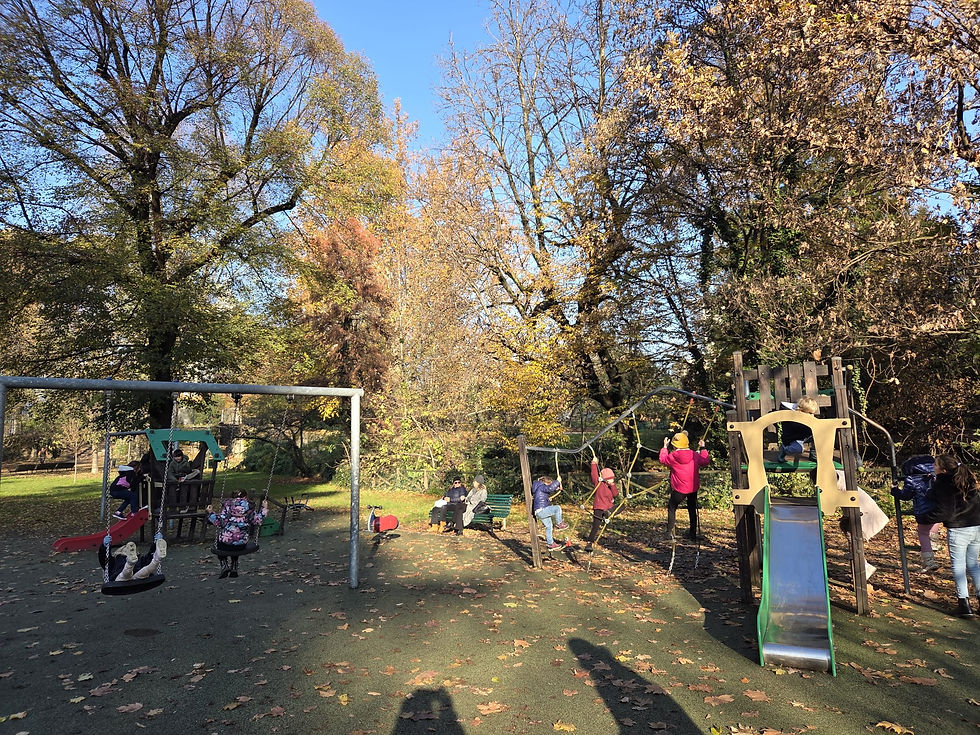
And then? We went to the playground.
Because after hours of intense concentration, the body needs free movement. Deep learning also requires moments of "digestion" - running, climbing, playing, laughing.
Balance is part of education.
Why It Works: The Science of Experiential Learning

Going out isn't just "nice" or "motivating." It's neurologically more effective.
Neuroscience tells us that experiential learning creates stronger and more lasting neural connections than passive learning.
When a child:
Sees a real skeleton (visual input)
Touches it or approaches it (spatial input)
Listens to a contextualized explanation (auditory input)
Asks questions and receives answers (active processing)
Experiences emotions (wonder, curiosity, joy)
...the brain activates multiple areas simultaneously: visual cortex, motor area, temporal lobes (language), limbic system (emotions), hippocampus (memory).
This simultaneous activation creates integrated neural networks. The memory isn't just "I saw a skeleton." It's "I remember when we took the metro, arrived at the museum, recognized Homo ergaster, asked a question about bipedal posture, and then played at the park with my classmates."
It's a multidimensional memory, anchored to emotions, movement, social context.
And these memories last.
A 2018 study published in Educational Psychology Review showed that students who participate in experiential learning experiences remember 90% of information even after weeks, compared to 20-30% of those who learn only through reading or lectures.
Maria Montessori knew this 100 years ago, without neuroimaging. Today science confirms: the world is the best learning laboratory.
What Parents Can Do
Going out isn't just for school.
Families can support this form of learning at home too, with small progressive outings that build autonomy and confidence.
Practical ideas by age:
6-7 years:
Going to the supermarket together: the child has the list, finds products, checks prices
Neighborhood library: the child chooses books, learns to use the lending system
Neighborhood walks: observing, naming, orienting
8-9 years:
Small independent errands: buying bread, taking a letter to the post office (with distant supervision)
Using public transportation together, then gradually alone (if safe)
Visits to museums, markets, artisan workshops
10-11 years:
Independent outings with friends (park, library, sports activities)
Managing small amounts of money
Planning an outing (where, how, when, budget)
Guiding principles:
Prepare, but don't substitute - Explain, show, accompany the first times. Then let them do it.
Trust - Parental anxiety is normal, but children sense our trust (or lack thereof). If we believe in them, they believe in themselves.
Accept mistakes - Did the child get off at the wrong metro stop? Bought the wrong product? That's okay. Mistakes are information, not failure.
Celebrate autonomy - Not with "good job!", but with sincere recognition: "You handled everything by yourself. I'm proud of you."
Conclusion
When the children returned to school, we asked them: "What did you like best?"
The answers: "I saw the skeleton we had drawn!" "I learned to read the metro stops and listen to the announcements." "I liked it when the museum lady asked us questions and I knew the answers." "The playground was beautiful!"
All correct answers.
Because going out isn't just the museum. It's the entire journey. It's autonomy, discovery, wonder, play, responsibility.
It's learning to inhabit the world.
The classroom is important. Montessori materials are precious. Books are fundamental.
But the world - with its trains, museums, experts, fossils, parks - is our true classroom.**
💚
Francesca
Founder of Montessori Academy
Want to learn more about Montessori education for Elementary (ages 6-12)?
Subscribe to our newsletter to receive insights, practical strategies for supporting children of this age, and updates on Montessori Academy activities.


Comments